I came home from Paphos with new tools, new friends, and a head full of observations. Between 25 April and 3 May 2026 I took part in Mastering AI in Non-Formal Education, an Erasmus+ training course for youth workers. I went as a participant, but I could not switch off the professional eye of an accessibility consultant. This post is where some of those observations are going.
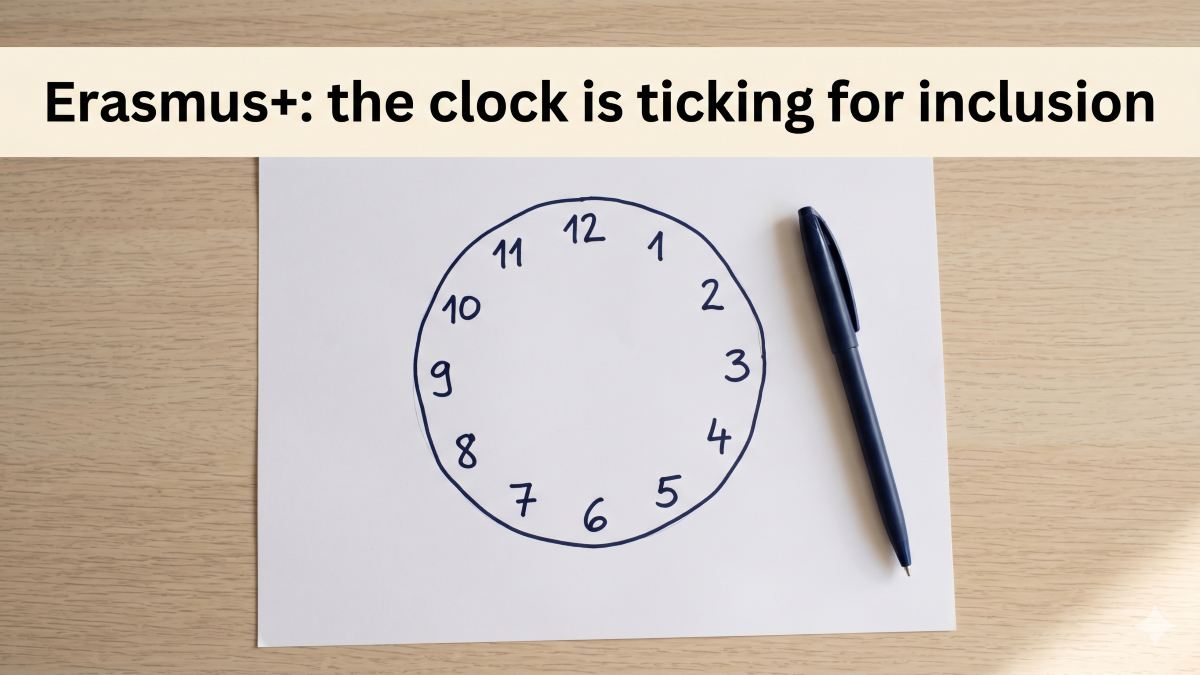
On the first day in Paphos, the trainer asked us to draw a clock on a piece of paper. Twelve slots, one for each hour. Then we were to walk around the room, pick people at random, and book them in for a speed date at three, at seven, at eleven. This was a name game, a way to remember faces.
The first minutes felt discouraging. I am not someone who needs help all the time. But this game asked for too many things at once. This is not about whether I could manage. It is about the tone a game like this sets on day one. The activity fit sociable extroverts who could draw, move, and approach strangers. With a small change, the same minutes could welcome a much wider group.
This is not a complaint. The trainers were warm. The content was useful. I am writing this for trainers who want their activities to reach more people, and for organisations starting to ask what inclusion looks like in practice.
Most activities still assume sight, paper, and touch
The clock game was not the only one. All week, the energisers, icebreakers, and learning methods asked for the same things from us. Writing, drawing, copying gestures, touching another person. Each one leaves someone out.
Most of these games have an accessible version. There is almost always an alternative to drawing, touching, pointing, or silent demonstration. The logic of the activity stays. Only the channel changes.
Visible needs are easier to plan for than invisible ones
A wheelchair is visible. A white cane is visible. Trainers tend to know what to do when they see one. Social anxiety is not visible. Sensory sensitivities are not visible. A person who does not want to be touched looks the same as one who loves a group hug. Energisers that involve close contact, sudden noise, or being put on the spot can be hard for reasons no one can see.
A trainer cannot always know what each person needs. But there are simple practices that help. A private check-in at the start. An activity offered in two versions. Permission to step out of an exercise without explaining why.
Asking is the first step
The organisers did ask. Two days before the course, we filled in a form with a question about access needs. That is good practice. To make it work, two things are needed. Enough time for the answers to reach the trainers and shape the activities. And a short, private check-in on day one to catch what the form could not. I have had this experience before, with trainers who came to me directly and asked what they could do. It changed the week.
A small bright spot
The week gave me three openings to bring accessibility into the conversation. Once with numbers on digital exclusion in Europe. Once about AI tools, since not all of them are equally accessible. And once about activity design, where some tasks can frustrate people who need more time. Each time, others in the room came over to say they had not thought about these things before, and that they had learned something. I am always open to explaining, and the curiosity in those moments is what stays with me.
Seven years on
This was my first Erasmus+ training in seven years. I came back curious to see what had changed. Honestly, less than I hoped. There are many projects about inclusion now, and that matters. But what I saw still works for the same kind of person it always did. The venue was the clearest example. Narrow corridors, obstacles along the way, and one buffet table at every meal with no thought for anyone who could not stand and reach. We talk about inclusion more than we design for it.
What good looks like
An inclusive training week is not a perfect one. It is one where the trainer narrates what they are doing. Where the games have a verbal version as well as a visual one. Where the intake form leads to a real conversation. Where invisible needs are taken as seriously as visible ones. Where the venue can hold every body in the room.
If you are a trainer reading this and you want to talk through your own activities, I am happy to. Helping non-formal educators design more inclusive sessions is part of what I do at Access In Focus, and it is some of the work I enjoy most.

